
Aux Heat vs. Emergency Heat: What Your Thermostat Display Is Actually Telling You
Give us a call today: 503-254-1274
You wake up, it’s cold, and your thermostat is showing “AUX HEAT” or “EM HEAT.” Before you panic (or Google what it’s going to cost you), take a breath. These are some of the most common calls we get in winter. Most of the time, a quick explanation is all it takes to resolve it. Occasionally, it can save you from a rash decision that could add a few hundred dollars to your heating bill.
Here’s what Aux and Em heat modes mean and when something actually needs your attention.
Your Heat Pump Isn’t Working Alone
A heat pump doesn’t generate heat the way a furnace does. It pulls heat from outdoor air and moves it inside. It’s efficient at this, even in cold weather, but it has limits. When temperatures drop low enough, it starts struggling to keep up on its own. That’s where backup heating comes in.
Most systems include a secondary heat source for exactly this situation. In all-electric homes, that’s usually electric heat strips inside the air handler. Think of them like a large toaster coil that produces heat when electricity runs through it. In a dual-fuel system, a gas furnace serves as the backup. Either way, your secondary heat source helps keep your home warm when the heat pump can’t keep up.
Aux heat and em heat are specific to heat pump systems. If your home runs on a gas furnace, electric furnace, or baseboard heat, you won’t see these settings show on your thermostat. Mini-splits are also heat pumps, so the same concepts apply, though the controls and display may look a little different depending on your brand.
What Aux Heat Means
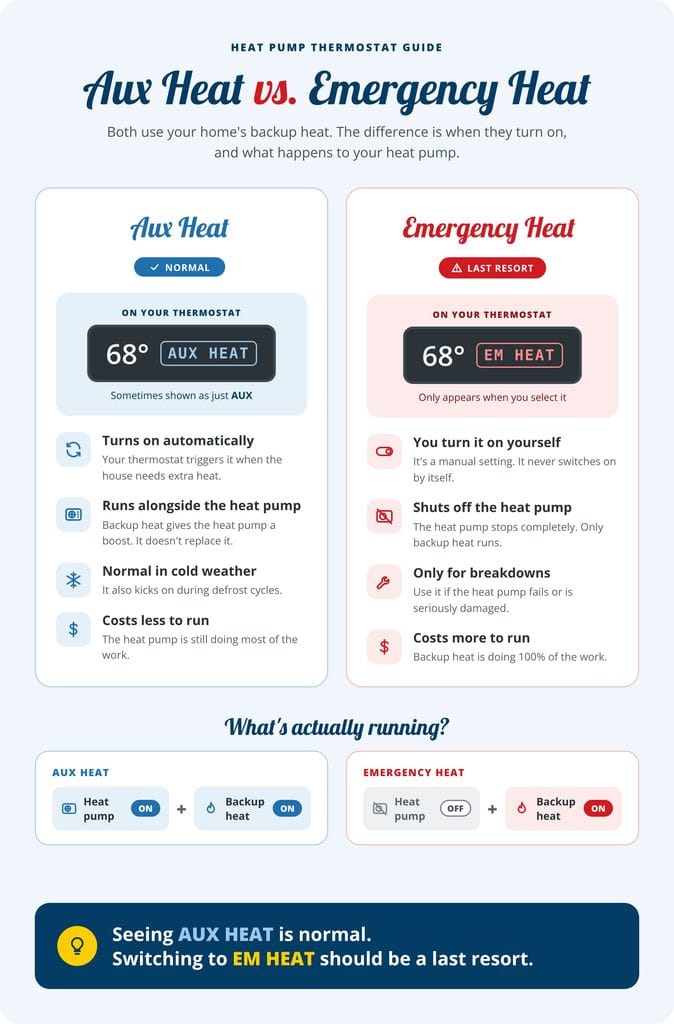
Aux heat is your system’s automatic backup. When your heat pump isn’t enough on its own, the thermostat pulls in the backup heat source to help close the gap. This usually happens when outdoor temperatures drop near or below freezing, or when you raise the thermostat by several degrees at once.
Aux heat doesn’t require any action from you to trigger it. The thermostat handles it automatically. It assesses the gap between your indoor temperature and desired setpoint, factors in what’s happening outside, and decides whether the heat pump needs backup support. When it does, “AUX” or “AUX HEAT” will show up on the display.
Seeing that on a cold Oregon morning, or right after you’ve bumped the thermostat up a few degrees, doesn’t mean anything is wrong. The system is doing exactly what it’s supposed to do.
It also kicks in automatically during the heat pump’s defrost cycle. Heat pumps occasionally need to briefly reverse operation to melt frost off the outdoor coil. During those few minutes, aux heat keeps the warm air coming inside. This is the expected behavior.
If your aux heat runs too often or in conditions that don’t warrant it, it becomes expensive, and you’ll likely need to get it checked.
What Emergency Heat Means and Why It’s Different
Unlike Aux heat, Emergency heat isn’t automatic. It’s a manual setting you choose on your thermostat, and it serves one specific purpose: to keep your home warm when the heat pump has failed.
When you switch to em (emergency) heat, the thermostat shuts off the outdoor unit completely and runs only the backup heat source. The heat pump is out of the picture. All of your home’s heat is coming from the electric heat strips or gas furnace alone.
That sounds similar to aux heat, and the equipment is often the same. The difference is that emergency heat bypasses the heat pump entirely rather than supplementing it. With aux heat, your heat pump is still doing most of the work. In em heat mode, the backup is handling everything.
Why this matters: Em heat mode costs more to run.
- A heat pump moves heat rather than creating it, delivering an efficiency rate of 3:1
(3 units of warmth for every 1 unit of electricity) - Electric heat strips directly convert electricity into heat at an efficiency rate of 1:1
(1 unit of warmth for every 1 unit of electricity).
Relying on backup heat alone is significantly more expensive, and you’ll see it on your bill. If your backup is a gas furnace, the cost difference depends on your local utility rates, but you’ll still notice the change compared to normal heat pump operation.
Em heat is the right call when the outdoor unit is dead, visibly damaged, or making noises that suggest a mechanical failure. It’s also appropriate if the unit is frozen solid and the defrost cycle isn’t clearing it, or if a technician has specifically told you to use it while waiting for a repair. Outside of those situations, leave the heat pump in charge; your thermostat is already handling it.
Aux Heat vs Emergency Heat: The Short Version
Both modes use the same backup heating equipment. The difference is who’s in charge and whether the heat pump is still running.
- Aux heat is automatic. It runs alongside the heat pump as part of normal cold-weather operation. It’s less expensive than full backup heating because the heat pump is still doing most of the work.
- Em heat is a manual override. It shuts the heat pump off completely and should be used only when the heat pump has failed or is offline for service.
Switching to emergency heat just because it’s cold outside, even very cold, is one of the most common and costly mistakes we see. Your thermostat is already managing this for you. Let it.
When Aux Heat Running Is a Problem
Seeing aux heat run occasionally is fine. But if it runs constantly, especially when it’s in the 40s or above outside, that’s a different story.
A properly working heat pump should handle your home’s heating without much backup support at those temperatures. If it isn’t keeping up, that’s worth looking into. It could be a refrigerant issue, a problem with the outdoor unit, a thermostat or wiring fault, or an undersized or aging heat pump.
Another common trigger is thermostat habits. If you drop the temperature eight degrees at night and raise it again every morning, you’re almost guaranteeing aux heat runs every time the system tries to catch up. Smaller, more gradual changes give the heat pump time to respond on its own.
Simple Ways to Reduce What You Spend on Aux Heat
You have more control over aux heat costs than most people realize. How often it runs, how long each cycle lasts, and what fuel it uses all make a difference.
- Keep thermostat changes small. Raising or lowering your temperature by one to two degrees at a time, rather than five to eight, gives the heat pump a chance to respond without pulling in backup heat. A programmable or smart thermostat can handle gradual changes automatically, which makes a real difference over the course of a winter.
- Keep up with filter changes. A clogged filter restricts airflow and forces the heat pump to work harder than it should. Swapping it out every one to three months during the heating season is one of the simplest things you can do.
- Keep the outdoor unit clear. Snow and ice buildup makes it harder for the heat pump to pull heat from outside air. After a heavy snowfall, clear the area around the unit and make sure nothing is blocking airflow.
- Annual maintenance helps here too. A technician can verify that defrost mode works correctly, check that backup heat staging is configured properly, and catch small issues before they start adding up on your bill.
If AUX HEAT Is On and Something Feels Off
Most of the time, “AUX HEAT” on your display just means the system is doing its job in cold weather. But a few situations are worth a call.
- If aux heat runs continuously and it’s above 40 degrees outside, it’s worth a look.
- If your heating bills have jumped noticeably compared to the same time last year and you haven’t changed your thermostat habits.
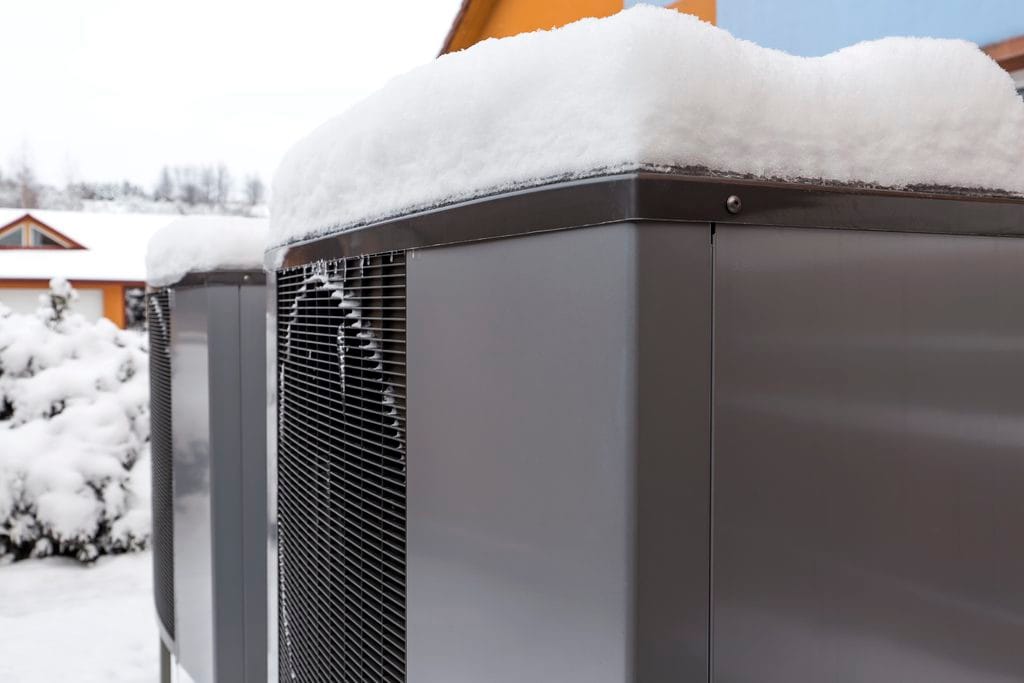
- If the outdoor unit is iced over — not light frost but a solid block of ice — and the defrost cycle isn’t clearing it, that’s a repair situation, not a settings fix.
When in doubt, call us. More often than not, the answer is easy.
Frequently Asked Questions
Why is my aux heat on when it’s not that cold outside?
A few things can cause this. The most common is a large, sudden change to your thermostat setting. The system triggers aux heat to close the gap quickly. Beyond that, it can point to a refrigerant issue, an outdoor unit that isn’t performing the way it should, or a thermostat configuration problem. If it’s happening regularly in mild weather, it’s worth having someone take a look.
What does aux heat mean on a thermostat in practical terms?
It means your heat pump is getting help from the backup heat source. In cold temperatures, that’s expected. In mild temperatures, or when it runs for long stretches without stopping, it can signal a problem.
When should I use emergency heat?
Only when the heat pump has failed or been taken offline. That means a mechanical breakdown, a severely damaged outdoor unit, or a situation where a technician has told you the heat pump shouldn’t run. Not for routine cold weather, even extreme cold. Your thermostat handles that automatically.
Will switching to emergency heat damage my system?
The mode itself won’t cause damage. The cost is the concern. Running solely on backup heating, especially electric resistance heat, for extended periods is significantly more expensive than normal operation. Use it when you need it and get the heat pump repaired as quickly as you can.
How do I know if my backup heat is electric strips or a gas furnace?
Look at your indoor unit. If there’s a gas line and a flue pipe connected to a furnace, your backup heat is gas. If there’s no gas line and a breaker in your panel is labeled “heat strips,” you’ve got electric resistance heat strips. Your original installation paperwork will also specify this. If you’re not sure, we’re happy to take a look.
How Can We Help You?


See What Our Community Has to Say